
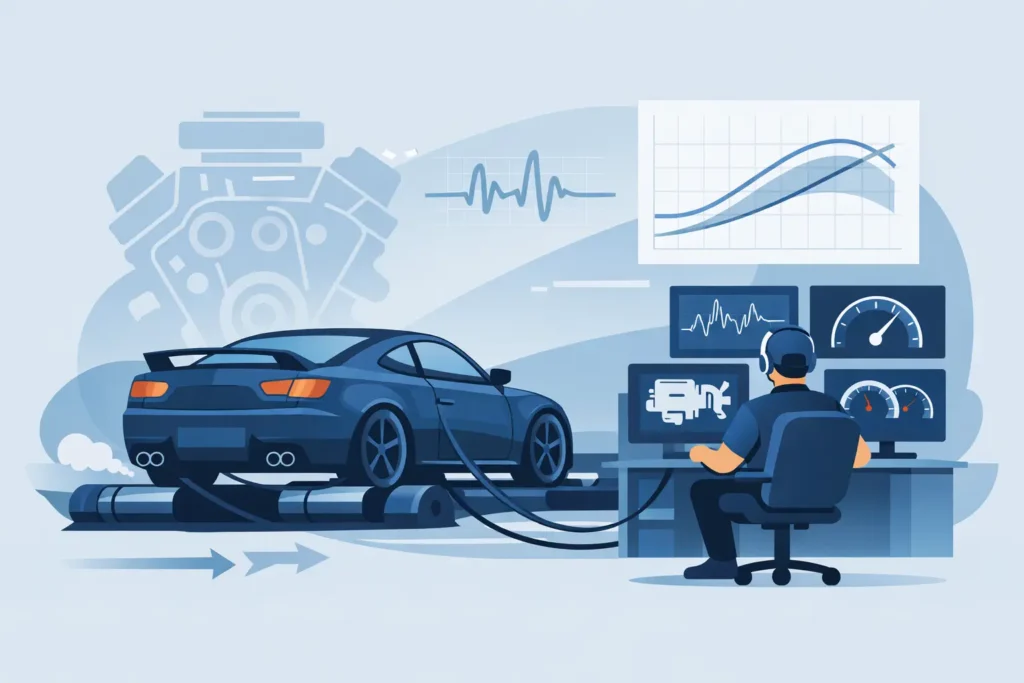
A file can look good on paper and still create problems the moment the car hits load. That is exactly why dyno tested tuning files matter to professional tuners. If you are building a business around ECU remapping, you are not selling a theory. You are selling results the customer can feel, repeat, and trust.
For a workshop, the difference shows up fast. One file delivers smooth torque, stable boost control, clean drivability, and predictable exhaust temperatures. Another may produce a flashy peak number but come back with limp mode complaints, smoke, gearbox issues, or inconsistent power across the rev range. The dyno is where those differences stop being assumptions and become measured facts.
What dyno tested tuning files actually mean
The phrase gets used loosely in this market, so it is worth being precise. Dyno tested tuning files are calibrations that have been validated under controlled load on a dynamometer, with actual data reviewed during development or final verification. That usually includes power and torque measurement, but the real value is in checking how the calibration behaves across the full operating range.
A proper dyno session is not just one wide open throttle pull and a printout. It gives the tuner a chance to assess boost behavior, rail pressure, AFR or lambda where relevant, torque intervention, ignition or injection behavior, EGT trends, throttle response, and power delivery under repeatable conditions. That is what separates a tested file from a guessed file.
For professional workshops, this matters because customers rarely judge a tune by one number alone. They judge it by drivability, consistency, and whether the vehicle performs well after it leaves the shop.
Why dyno tested tuning files reduce workshop risk
The biggest cost in tuning is not always the first file. It is the comeback. A car that returns with hesitation, overboost, poor cold start behavior, smoke under load, or transmission complaints costs time, credibility, and profit.
Dyno testing reduces that risk because it exposes problems before the customer does. If torque rises too aggressively in the mid-range, if boost control oscillates, or if a hardware limit is reached earlier than expected, those issues can often be seen on the dyno while there is still time to correct them. That is especially important when you are working across different ECU generations, engine variants, fuel qualities, and hardware conditions.
There is also a business reality here. A workshop needs repeatable processes. When you rely on tested calibrations, you shorten diagnostic time, reduce trial-and-error revisions, and give your team more confidence when delivering a vehicle. That directly supports margin and throughput.
Power is only one part of the job
Many less experienced tuners focus too much on peak output. Customers like power figures, but the workshop has to manage the full picture. A car with an extra 15 horsepower but poor part-throttle behavior is not a good result. A diesel with an aggressive torque spike that stresses the clutch is not a smart file. A gasoline turbo tune that looks strong for one pull but runs too hot on repeated acceleration is not ready for real-world use.
Dyno validation helps tune for the whole operating window, not just the headline.
What a professional tuner should expect from tested files
If you are buying files from a supplier, the words tested or validated should mean something practical. You should expect the calibration to be based on real vehicle behavior, not only map theory or automated adjustments.
That includes sensible torque modeling, controlled boost targets, stable rail pressure requests where applicable, and calibration changes that work together instead of fighting each other. On modern ECUs, that coordination matters. Changing one limiter without understanding how it interacts with driver wish, torque monitoring, smoke limitation, temperature protections, or gearbox logic is where poor files start.
Dyno tested tuning files should also reflect workshop reality. Not every car is perfect. Some are high mileage. Some have small hardware deviations. Some run on lower-quality fuel than ideal. A strong file supplier understands that usable performance often beats chasing the last possible number.
Tested does not mean identical on every vehicle
This is where nuance matters. Dyno validation improves reliability, but it does not erase vehicle-to-vehicle variation. Two supposedly identical cars can respond differently due to maintenance history, sensor drift, fuel quality, intake restrictions, turbo condition, or transmission adaptation.
That is why serious file development combines tested base strategies with case-by-case adjustment when needed. A dyno tested file gives you a stronger starting point and a safer calibration logic. It does not replace diagnostics, logging, or workshop judgment.
Dyno tested tuning files vs generic database files
Generic database files have their place. They can be useful for speed, common applications, and standardized jobs. But the risk increases when a file is treated like a one-size-fits-all product.
A generic file may be built around a narrow sample set, copied from another market, or adjusted without proper verification on the exact control strategy. It might work well on ten cars and then cause trouble on the eleventh. That is a problem if your business depends on consistency.
Dyno tested tuning files usually offer a better balance between performance and control because they have been checked under load and refined against measured behavior. For a workshop, that often means fewer surprises after flashing. The gain is not just technical. It is operational. You spend less time troubleshooting and more time invoicing completed jobs.
Where dyno validation matters most
Not every job carries the same level of risk. A mild Stage 1 tune on a common platform is different from a heavily modified setup or a commercial diesel that works under constant load. Still, dyno testing becomes especially valuable in a few situations.
It matters on torque-heavy diesel applications where transmission and clutch limits need respect. It matters on turbo gasoline engines where ignition strategy, knock sensitivity, and thermal control can make a huge difference. It matters on DPF, EGR, or AdBlue-related solutions because software changes can affect broader system behavior if they are not handled correctly. And it matters on performance builds where upgraded hardware changes the airflow and fueling model enough that assumptions become expensive.
For shops scaling up volume, it also matters because process quality becomes harder to maintain as car count increases. Tested files create a more dependable baseline for the team.
How to evaluate a file supplier claiming dyno testing
Not every supplier who says dyno tested is working to the same standard. Ask practical questions. Was the file developed and refined on real vehicles? Was the dyno work part of calibration development or only a marketing screenshot after the fact? Can the supplier explain how the tune manages torque, boost, temperature, and drivability instead of only quoting gains?
Support matters just as much as the original file. If a car behaves differently than expected, you need a partner who can review logs, adjust the calibration, and respond quickly. That is where a serious file service stands apart from a bulk reseller.
The best suppliers combine dyno validation with workshop experience. They understand what happens after the flash because they deal with actual vehicles, customer expectations, and shop pressure every day. That hands-on perspective is often what turns a decent file into a dependable one.
Why this matters for business growth
Customers may come in asking for more power, but they come back because the job was clean. No strange behavior. No warning lights. No excuses. Just a stronger vehicle that drives the way it should.
That outcome starts with the calibration you choose to install. Dyno tested tuning files help protect your reputation because they support better consistency, safer gains, and stronger confidence at delivery. For a growing tuning business, that is not a small advantage. It is part of your operating model.
At Lion Chiptuning Files, that is why tested quality control and workshop-backed support matter so much. Fast delivery is valuable, but only when the file behind it is calibrated to perform properly in the real world.
The shops that last in this industry are not usually the ones chasing the biggest claims. They are the ones building trust, one proven car at a time.