
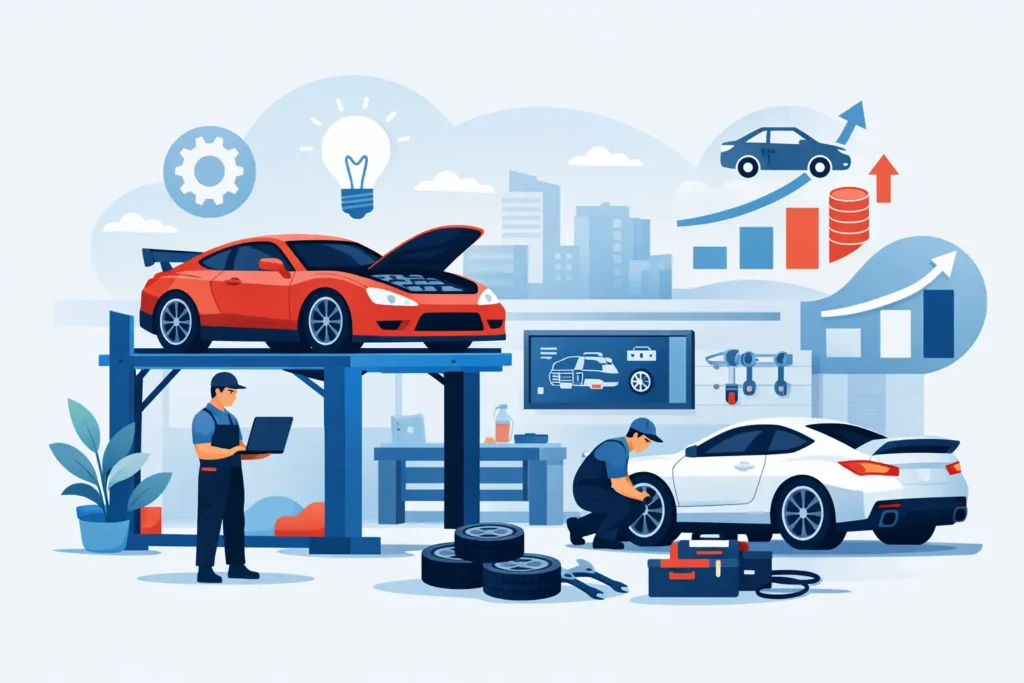
A tuning workshop usually does not stall because demand disappears. It stalls because the owner becomes the bottleneck. Too many file requests depend on one person, too many jobs take too long to quote, and too much revenue is tied to inconsistent outcomes. If you want to grow automotive tuning workshop capacity in a way that actually holds up, you need more than new customers. You need a model that protects quality while increasing throughput.
That is the real shift from a busy shop to a scalable one. More cars through the door only helps if your process, file supply, support, and delivery standards can keep pace. In tuning, growth is never just marketing. It is operations, trust, turnaround time, and repeatable technical results.
What actually limits workshop growth
Most tuning businesses think first about lead generation, but growth problems often start further down the line. If your team is waiting on files, rechecking uncertain calibrations, or spending too much time explaining delays to customers, your sales effort creates pressure instead of profit.
The common ceiling is not a lack of work. It is a lack of structure. A workshop that can tune five vehicles a day with one technician does not automatically become a workshop that can handle ten by hiring another person. The second stage requires cleaner intake, better job qualification, predictable file turnaround, and a dependable technical partner when edge cases show up.
There is also a credibility issue. Customers may come in asking for more power, but what they really buy is confidence. They want the car to perform well, drive correctly, and leave without warning lights, limp mode issues, or unfinished delete requests. If your quality varies, your reputation will limit growth long before your local market does.
How to grow automotive tuning workshop revenue without breaking quality
A strong workshop grows by increasing value per job, improving conversion, and reducing wasted labor. Those three levers matter more than simply lowering prices or pushing volume.
Higher value per job starts with positioning. If you sell tuning like a generic commodity, customers will compare you to the cheapest option online. If you sell tested results, calibrated files, and workshop-level support, you move the conversation away from price alone. That is especially true when dealing with modern ECUs, commercial vehicles, or systems where poor file quality creates expensive comebacks.
Conversion improves when your process feels professional from the first call. Customers notice whether you ask the right technical questions, whether you understand the platform, and whether you can explain realistic gains and limitations. Overpromising might win one sale, but accurate expectations build repeat work and referrals.
Reducing wasted labor means looking hard at all the time your team spends on non-billable effort. That includes chasing incomplete file information, fixing poor previous work, repeating manual admin, and waiting too long for a response on urgent jobs. A workshop with better support infrastructure often outperforms a workshop with more raw tuning talent but weaker systems.
Build your workshop around speed and repeatability
In this business, speed matters, but only when it is controlled. Fast delivery with unreliable results creates more damage than value. The goal is repeatable speed – a process where customers know what will happen, your team knows what to collect, and file turnaround fits the pace of the workshop.
That starts at intake. Every vehicle should come in with a clear workflow for identification, read method, customer request, hardware status, and risk factors. If technicians and service staff gather different information every time, you create file delays before the job even starts.
The next part is standardizing your common jobs. Stage 1 tuning, EGR solutions, DPF-related work, AdBlue solutions, gearbox tuning, and common commercial platforms should not be treated like first-time experiments every week. You need defined internal procedures for pricing, customer communication, and post-flash checks.
This is where a serious file partner changes the economics of the workshop. When you can upload the original file, request the correct modification, and get a calibrated result back quickly, your shop floor keeps moving. More important, your technicians spend more time completing jobs and less time compensating for poor support. For many growing businesses, that is the difference between being a tuner and running a tuning company.
Your file supplier is part of your growth strategy
If you want to grow automotive tuning workshop performance over the long term, your file supply cannot be an afterthought. Cheap files with uncertain validation may look profitable on paper, but they cost you margin through delays, customer complaints, and rework.
A good file partner should give you confidence in three areas: file quality, response speed, and technical backup. You need tested solutions, not guesswork. You need fast turnaround, not vague promises. And when a vehicle has an unusual software version or a job does not behave as expected, you need direct support from people who understand workshop pressure.
That matters even more as your service mix expands. Many workshops start with basic remaps and then move into more advanced work because the demand is there. But broader services only help if the support behind them is equally strong. A partner with real experience in dyno-tested files, slave and master workflows, and practical workshop troubleshooting gives you room to scale without taking unnecessary risks.
Lion Chiptuning Files fits this model because it operates as a technical partner, not just a file seller. For a workshop that wants faster turnaround and more dependable calibrated solutions, that kind of support makes growth more realistic.
Train your sales process like you train your technicians
A surprising number of tuning shops lose money before the vehicle even enters the bay. The issue is not poor demand. It is weak qualification. Every serious workshop should have a consistent way to handle calls, messages, and quote requests.
You do not need a scripted corporate sales process. You do need discipline. Ask what the customer drives, what hardware is on the car, whether the vehicle has faults, what outcome they want, and how they use the vehicle. A daily-driven diesel, a fleet van, and a weekend performance build should not be sold the same way.
Good sales qualification does two things. First, it improves close rates because customers feel they are speaking with a specialist, not a generalist. Second, it protects workshop efficiency by filtering out poor-fit jobs, unrealistic expectations, and vehicles likely to create headaches.
This is also where upselling becomes legitimate instead of pushy. If a customer comes in for a basic remap but also has drivability issues related to emissions systems or transmission behavior, solving the broader problem creates more value for both sides. The key is relevance. Sell what improves the finished result, not what simply inflates the invoice.
Growth comes from retention, not just new cars
The fastest-growing workshops usually have a strong base of repeat customers, dealer relationships, and trade clients. That kind of growth is less glamorous than chasing social media attention, but it is more stable and usually more profitable.
A customer who trusts your work returns with a second vehicle, recommends you to other owners, or sends business customers your way. A local garage that sees you handle difficult software jobs reliably can become a steady source of referrals. These relationships are built on consistency. If your communication, turnaround, and outcomes vary from week to week, retention suffers.
Trade partnerships are especially valuable because they increase volume without requiring you to market every individual job. But they also raise the standard. Other businesses need you to be dependable, responsive, and technically sharp. If you want dealer networks or B2B workshop relationships, your backend process has to be built for it.
Add capacity carefully
Hiring too early can hurt just as much as hiring too late. A larger team only helps if your workflow is documented and your quality control is tight. Otherwise, you multiply mistakes.
Before adding staff, ask whether the real issue is labor or process. If the workshop loses time because jobs are poorly scheduled, file requests are disorganized, or customer handoffs are inconsistent, another technician will not solve the core problem. Clean systems first, then expand headcount.
The same rule applies to adding services. Offering every tuning-related solution sounds attractive, but complexity has a cost. It may be smarter to dominate a few high-demand, high-confidence service categories before broadening your range. Growth should improve control, not dilute it.
The workshops that scale best are not always the loudest. They are the ones that deliver strong results quickly, price with confidence, and build operations around proven support. If you keep tightening those fundamentals, growth stops feeling unpredictable and starts feeling earned.