
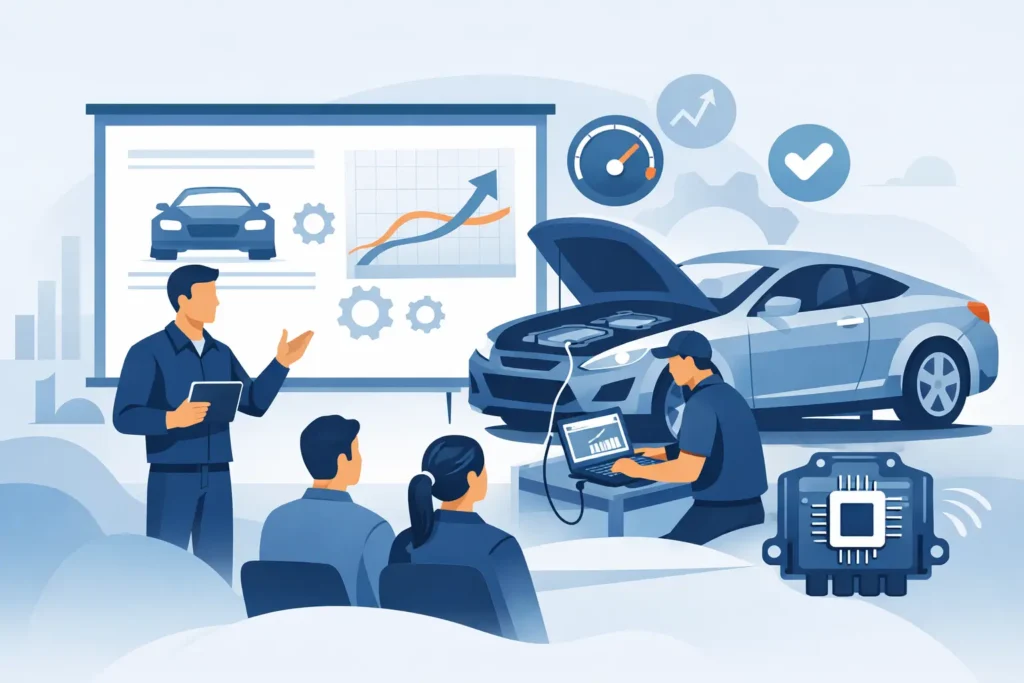
A dealer can buy tools in a week, set up a website in a day, and start advertising tuning almost immediately. That does not mean the business is ready. Chiptuning training for dealers matters because the gap between selling tuning and delivering it professionally is where most problems start – bad expectations, poor diagnostics, weak file requests, and support delays that cost trust.
For a workshop or tuning business, training is not just about learning how to read and write an ECU. The real value is learning how to run a profitable, low-risk operation around tuning services. That includes customer intake, vehicle checks, tool compatibility, file communication, problem escalation, and knowing when not to flash a car. Dealers who understand that early usually grow faster and create fewer expensive mistakes.
What good chiptuning training for dealers should actually cover
A lot of training in this market is too narrow. It shows the software, explains basic tool use, and stops there. That may be enough for someone experimenting with one or two vehicles, but not for a business that wants repeatable results.
Good dealer training starts with process. Before anyone talks about power gains, torque limits, or switchable options, the workshop needs a method for handling vehicles properly. That means checking the vehicle condition, verifying hardware and software versions, identifying previous tuning, and collecting the right file data from the start. If those basics are weak, even a perfectly calibrated file can end up blamed for a mechanical problem.
Technical training also needs to match the dealer’s business model. A newer workshop using slave tools and relying on file service support needs different guidance than a master tuner building in-house solutions. Both need technical understanding, but not in the same depth or sequence. For slave dealers, the priority is usually clean file handling, accurate job requests, and reliable communication with the file supplier. For master-level businesses, the training has to go deeper into map structure, checksum logic, solution validation, and software strategy.
That is why broad claims about becoming a tuning expert in a short course should be treated carefully. Real dealer education is layered. It starts with safe operations and grows into stronger technical decision-making over time.
The difference between tool training and business-ready training
This is where many dealers lose time and margin. Tool training teaches you where to click. Business-ready training teaches you how to deliver tuning profitably inside a real workshop environment.
A dealer who only knows the tool can still struggle with blocked reads, unsupported protocols, battery stabilization, failed write recovery, and customer complaints after a flash. A dealer with proper operational training knows how to reduce those risks before they turn into support tickets.
Business-ready training should include customer-side judgment as well. Not every vehicle is a good tuning candidate on the day it arrives. A car with active fault codes, poor service history, DPF issues, boost leaks, or transmission concerns needs diagnosis first. Serious training teaches dealers to protect their reputation by refusing or postponing jobs when necessary. That can feel like lost revenue in the moment, but it usually saves far more than it costs.
There is also a commercial side that should not be ignored. Dealers need to know how to quote different stages properly, explain realistic gains, position economy tuning versus performance tuning, and set expectations around supporting mods. If training skips this, the workshop may know how to flash cars but still struggle to build a stable tuning business.
Why support matters as much as the course itself
The course is only the beginning. The real test comes when a dealer is in the workshop with a customer waiting, the vehicle is not behaving as expected, and a fast decision is needed.
That is why ongoing technical support should be treated as part of the training package, not as a separate extra. Dealers improve fastest when they can ask practical questions tied to real jobs. It is one thing to explain ECU families in a classroom setting. It is another to help a workshop handle a difficult read, identify a modified original file, or understand why a requested solution is not advisable for a specific vehicle.
This is where a training provider with real workshop experience stands apart from a generic reseller. Support becomes sharper, faster, and more useful when the people behind it have actually dealt with dyno testing, drivability issues, hardware limits, and failed assumptions in real vehicles. Theory matters, but workshop pressure exposes weak theory quickly.
For that reason, dealers should look beyond the course outline. Ask what happens after training. Is there file support? Can difficult cases be escalated? Are tested solutions available? Is there guidance for both slave and master workflows? If the answer is no, the dealer may finish the course with information but without a reliable path to delivery.
Chiptuning training for dealers is also about speed
Speed is not just a marketing claim. In this business, speed affects conversion, workshop planning, and customer confidence.
A well-trained dealer works faster because the intake is cleaner, the file request is clearer, and the process around the vehicle is more disciplined. That reduces back-and-forth with the file service and lowers the chance of avoidable delays. The workshop becomes easier to scale because the tuning side stops depending on guesswork.
But speed has a limit. Fast service only works if quality control is strong. Pushing vehicles through without proper checks creates rework, and rework destroys margin. So the goal is not maximum speed at any cost. The goal is controlled speed – quick turnaround supported by proper diagnostics, correct file handling, and tested calibrations.
That balance is exactly what dealers should want from training. Not hype. Not unrealistic claims. A system that helps them work quickly without creating unnecessary exposure.
What newer dealers should look for first
If you are building a tuning business from the ground up, the smartest move is usually not to chase the most advanced software editing course first. Start with training that helps you deliver consistent jobs safely.
That means learning tool usage, reading and writing procedures, battery support, vehicle assessment, and the structure of a good file request. It also means understanding what common systems like EGR, DPF, and AdBlue involve from a calibration and customer-service perspective. Even if you are not creating solutions yourself, you need enough technical understanding to speak clearly, avoid bad jobs, and communicate accurately with your file provider.
For many dealers, that stage is where the business becomes viable. You do not need to become a full-time calibrator on day one to sell tuning professionally. You do need solid training, dependable file support, and a process that works under workshop conditions.
What established workshops should expect from advanced dealer training
For an established workshop, basic training is not enough. The focus should shift toward efficiency, margin control, and technical depth.
Advanced dealer training should help your team standardize workflows, reduce failed requests, improve upsell opportunities, and handle more complex vehicle platforms with confidence. If you are working with higher volume, the training should also address internal delegation – who handles diagnostics, who manages file submission, who signs off on final delivery, and how issues are escalated.
This is also where access to better technical resources becomes valuable. WINOLS-related knowledge, map recognition, file comparison, and understanding validated solution logic can all strengthen the business. Even if your operation still depends heavily on supplied files, deeper technical knowledge improves communication, speeds up support, and makes your workshop more credible with serious customers.
Providers like Lion Chiptuning Files understand this part of the market because dealers do not just need education. They need an operational partner who can support growth without slowing down the workshop.
The best training reduces risk before it increases sales
Most dealers first think about training in terms of new revenue. That is reasonable, but the bigger benefit is usually risk reduction.
When your team knows how to inspect vehicles properly, request files correctly, set expectations clearly, and identify red flags early, you avoid many of the problems that damage a tuning business. You get fewer disputes, fewer repeat workshop visits, and fewer situations where a customer expects tuning to solve a mechanical fault.
Then sales improve naturally because the operation becomes more reliable. Customers feel the difference when a workshop is organized, confident, and technically clear. They may not know the calibration details, but they notice when the process is professional.
That is what dealer training should build. Not just knowledge, but delivery standards.
If you are choosing chiptuning training for dealers, look for something that improves how your workshop works on Monday morning, not just what sounds impressive on a course page. The right training should help you sell with confidence, flash with care, and grow without turning every difficult vehicle into a costly lesson.